
AccuThermo AW820V Vacuum RTP System
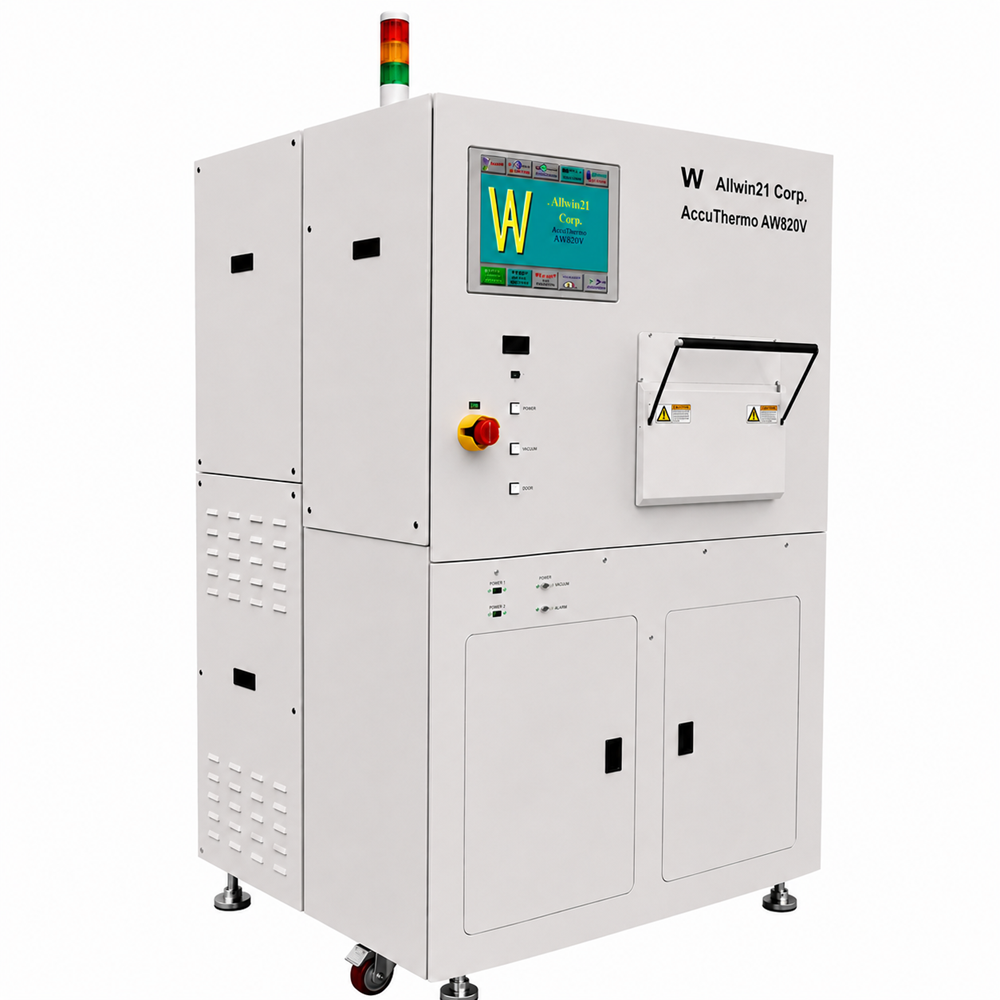
Vacuum RTP Configuration with Top & Bottom Lamp Heating
Standalone Manual Vacuum RTP System for up to 8-Inch Wafers
RTP Process Experience
Allwin21 applies RTP process understanding to help customers evaluate atmospheric RTP, vacuum RTP, automatic RTP, susceptor configuration, process gases, and thermal process requirements.
Customer Gets:
Practical model selection and application-oriented process discussion.
10-Zone Lamp Heating Control
The 27-lamp, 10-zone RTP thermal control architecture with independently controlled lamp zone heating provides improved thermal tuning capability, process repeatability, and thermal distribution control for different applications.
Customer Gets:
Flexible thermal tuning for compound semiconductor, metal-film, and susceptor-based RTP applications.
Process-Oriented RTP Software
The RTAPRO software architecture provides improved RTP process visibility, lamp-response monitoring, process troubleshooting capability, and long-term thermal stability management for process and equipment engineers.
Customer Gets:
Better process setup, easier troubleshooting, and more controlled RTP recipe development.
The AW820V is a manual vacuum RTP configuration for customers requiring vacuum pump-down, controlled process atmosphere, or optional higher vacuum capability. It uses the Allwin21 AW820 RTP platform while adding vacuum chamber hardware, main vacuum valve, top and bottom quartz windows, and shielded thermocouple temperature control.


1. Start with the Process Requirement
Vacuum RTP should be selected based on process requirements, not only by vacuum level. Many RTP applications can be processed using controlled atmospheric, nitrogen, argon, oxygen, or forming gas environments without requiring vacuum RTP configuration.
Customer Gets:
- More practical RTP model selection
- Avoidance of unnecessary system complexity
- Better matching between process requirement and equipment configuration
2. Top & Bottom Lamp Heating
Unlike many conventional vacuum RTP systems using top-side-only heating, the AW820V uses top and bottom lamp heating architecture. This configuration is useful for compound semiconductor, metal-film, and susceptor-based RTP applications.
Customer Gets:
- More balanced thermal structure
- Support for susceptor base and lid configurations
- Improved flexibility for compound semiconductor processing
3. Shielded TC Temperature Control
Because AW820V uses a vacuum chamber structure with thick upper and lower quartz windows, shielded thermocouple temperature control is typically used instead of standard RTP pyrometer temperature control.
Customer Gets:
- Temperature control compatible with vacuum chamber structure
- Practical configuration for manual vacuum RTP
- Application-oriented setup for customer process review
4. Allwin21 Application Review
Allwin21 can review the customer’s substrate, process temperature, process gas, pressure requirement, throughput target, susceptor requirement, and evaluation method to help determine whether AW820M, AW820R, AW820V, or AW820RV is the better starting point.
Customer Gets:
- Application-based model recommendation
- Reduced risk of over-specifying the equipment
- More suitable RTP configuration for the real process goal
Process Results vs. Temperature Uniformity
For RTP applications, direct TC temperature uniformity alone may not represent final process performance. Sheet resistance, film thickness, contact resistance, SEM results, and repeatability often provide more meaningful process evaluation.
Customer Gets:
- Better acceptance criteria
- Less confusion during process development
- More practical RTP evaluation
Atmospheric RTP vs. Vacuum RTP
Many RTP applications do not require vacuum RTP. For many processes, thermal repeatability, gas purity, O₂ / moisture control, chamber design, and process understanding are more important than vacuum level alone. Vacuum RTP systems may also introduce additional contamination sources, increased maintenance complexity, and reduced process repeatability at high temperatures due to chamber structure and cooling requirements.
Customer Gets:
- Avoid unnecessary complexity
- Better model selection
- Practical RTP configuration guidance
Cooling Water Stability
Closed-loop cooling water is recommended for stable RTP chamber cooling and long-term reliability. Because RTP is a high-temperature thermal processing system, a dedicated cooling-water loop is recommended whenever possible. Distilled water is recommended instead of D.I. water for chamber cooling.
Customer Gets:
- Reduced corrosion risk
- More stable chamber behavior
- Better long-term equipment reliability
Susceptor Selection
The appropriate susceptor depends on budget, substrate size, material, thickness, emissivity, wafer bow, backside surface condition, ramp-rate requirements, patterned surface condition, process temperature, throughput, and application requirements. Susceptor size and configuration can also affect achievable ramp rates, thermal repeatability, and process flexibility. Susceptor base or susceptor base + lid configurations may be recommended depending on process sensitivity and wafer surface conditions.
Customer Gets:
- Better process and budget matching
- Reduced wafer handling risk
- Improved thermal repeatability potential
- More suitable RTP configuration for application-specific process needs
| Item | AW820V Specification |
|---|---|
| Ramp-Up Rate | Programmable from 1°C to 250°C/sec.
More detailsTypical compound semiconductor applications use 1°C to 50°C/sec depending on process, substrate size, substrate material, and susceptor configuration.
|
| Steady-State Temperature | Typical steady-state range: 150°C to 1050°C.
More detailsMaximum temperature up to 1250°C depending on process conditions, wafer size, susceptor configuration, process gas, and system configuration. Typical RTP steady-state process time is usually less than 5 minutes for most RTP applications. The larger AW820M platform may support extended steady-state RTP applications, such as approximately 10 minutes at high temperature, depending on process conditions and facility capability. Longer high-temperature RTP processing should be reviewed with Allwin21 before application use, since process safety, chamber condition, utility stability, exhaust configuration, and facility capability become increasingly important for long-duration RTP operation.
|
| Steady-State Duration | 0 to 9999 seconds per recipe step.
More detailsTypical RTP applications use approximately 1 to 600 seconds per recipe step. Because AW820M uses a larger standalone chamber and chassis platform, extended steady-state RTP processing may be possible for suitable applications depending on process temperature, substrate type, process gas, cooling capability, exhaust configuration, and facility conditions. Long-duration high-temperature processing is traditionally more common with furnace systems. Customers considering extended steady-state RTP processing are encouraged to discuss their application goals with Allwin21 before use, especially when RTP is preferred instead of conventional furnace processing.
|
| Ramp-Down Rate | 1°C to 200°C/sec. Programmable within natural cooling capability.
More detailsActual cooling rate is temperature- and substrate-dependent. Cooling can be fast at high temperature and gradually decreases at lower temperature.
|
| Temperature Accuracy | ±1°C under controlled conditions. Shielded TC. |
| Temperature Repeatability | ±1°C or better at 1150°C under controlled conditions.
More detailsBased on wafer-to-wafer repeatability test under controlled process conditions. Actual repeatability depends on substrate, fixture, sensor configuration, process recipe, and facility stability.
|
| Temperature Uniformity | ±8°C across a 8″ / 200 mm wafer at 1150°C.
More detailsBased on one-sigma deviation from 100 Å oxide uniformity measurements. For a titanium-silicidation process, no more than 1.5% increase to uniformity during the first anneal at 650°C to 700°C.
RTP performance is application dependent. Allwin21 generally does not recommend using multi-point thermocouple wafers as the primary process monitoring method, especially above approximately 600°C, because the actual substrate temperature may differ from thermocouple readings and high-temperature thermocouple measurement itself has significant tolerance and process dependency. Final process results such as sheet resistance, film thickness, contact resistance, device performance, surface condition, or SEM results may be more meaningful process acceptance criteria. For production fabs, Allwin21 PowerSum monitoring can also be used as an effective process and equipment monitoring parameter for long-term RTP process control and drift monitoring. |
| Process / Purge Gases | Supports common RTP process and purge gases.
More detailsTypical gases include N₂, O₂, Ar, He, forming gas, NH₃, and N₂O. Process gases should be regulated to 30 PSIG and pre-filtered to 1 micron.
|
| Vacuum / Pressure Configuration | Typical 1 to 50 mTorr. Optional high-vacuum configuration.
More detailsTypical low-vacuum RTP configurations are commonly operated approximately in the 1 to 30 mTorr or 1 to 50 mTorr range depending on pump configuration, chamber condition, process gas, pressure-control method, leak rate, and customer application requirements.
Optional turbo-pump configuration may be reviewed for applications requiring higher vacuum capability. Typical high-vacuum configurations may reach approximately 10⁻⁵ to 10⁻⁷ Torr depending on chamber condition, pump configuration, plumbing, valve configuration, leak rate, process gas configuration, and facility setup.
Actual achievable vacuum performance and process suitability are application dependent and should be reviewed together with substrate material, process gas, temperature, susceptor configuration, process sequence, and customer evaluation method.
|
| Item | AW820V Standard Configuration |
|---|---|
| System Type | Standalone manual single-wafer vacuum RTP / RTA / RTO / RTN system. |
| Wafer Handling | Manual loading into vacuum chamber with quartz tray or application-specific susceptor. |
| Wafer Size Capability | Supports round and square substrates up to 8-inch class, configuration dependent.
More detailsSupports small samples, 2”, 3”, 4”, 5”, 6″ and 8” / 200 mm wafers depending on quartz tray, susceptor configuration, substrate thickness, wafer bow condition, and application requirements.
|
| Metal Chamber Assembly | AW820V vacuum RTP chamber with top and bottom quartz windows, 27 lamps, and 10-zone control.
More detailsIncludes vacuum chamber structure, top and bottom quartz windows, top and bottom infrared lamp heating module, and independent lamp-bank control with recipe-level lamp factor adjustment. The vacuum chamber structure is different from the standard atmospheric isolated quartz tube structure.
|
| Chassis Assembly | Large chassis and embedded industrial control computer.
More detailsIncludes large AW820 platform chassis, embedded industrial control computer for reduced ESD risk, main control electronics, DC power supply, vacuum control interface, vacuum pressure control valve, main vacuum valve, vacuum gauges / meters, N₂ purge line, process gas lines with MFCs, cooling water / CDA gauges, meters, valves, and switches.
|
| Standard Quartz Trays | Standard quartz trays available for 2 to 8 inch round and square substrates.
More detailsStandard quartz trays available for 4”–6” round wafers, 5”–8” round wafers, and 156×156 mm to 200×200 mm square wafers. Quartz tray selection depends on substrate size, shape, thickness, wafer bow condition, and application requirements. Application-specific tray configurations are also available.
|
| Thermocouple | One shielded K-type thermocouple assembly included.
More detailsAW820V vacuum RTP typically uses shielded thermocouple temperature measurement because of the vacuum chamber and quartz window configuration. Typical process temperature range is approximately 150°C to 1150°C depending on process conditions, substrate configuration, and application requirements.
|
| Manuals & Software | USB drive with manuals, software, and schematics included.
More detailsIncludes backup software, installation manual, operation manual, service manual, facility connection drawings, and AW820V schematics.
|
| Item | Optional Configuration / Capability |
| More Process Gas Lines | Optional additional process gas lines with support for up to 5 MFCs.
More detailsAW820V includes a dedicated N₂ purge line for vacuum chamber purge / backfill use. Additional process gas lines are available with optional shut-off valves, gas routing configurations, pressure control interface, and up to 5 MFCs depending on application-specific gas requirements.
|
| Application-Specific Susceptors | 3″, 4”, 6”, 8”, 16×2-inch, 5×3-inch, and 4×4-inch susceptors available.
More detailsSusceptor selection depends on substrate material, IR transparency, wafer size, patterned or metal-coated surfaces, backside condition, process sensitivity, repeatability requirements, throughput, ramp rate targets, and budget considerations.
Susceptor base or susceptor base + lid configurations are available depending on application requirements. Susceptors are commonly recommended for transparent substrates, small samples, patterned wafers, metal-coated wafers, and pyrometer-based RTP applications requiring stable thermal coupling and repeatable temperature measurement.
Larger susceptors generally reduce achievable ramp rates because of higher thermal mass. Smaller susceptors may support faster ramp rates, while larger multi-size susceptors provide better flexibility and throughput capability.
Long-term qualified SiC-coated graphite susceptors are recommended for best RTP repeatability and process stability. Single-wafer and multi-wafer susceptor configurations are available depending on process sensitivity and throughput requirements.
|
| Application-Specific Quartz Trays | Standard and/or Custom quartz trays available for special substrates.
More detailsStandard quartz trays available for 4”–6” round wafers, 5”–8” round wafers, and 156×156 mm to 200×200 mm square wafers. Custom quartz trays are available for special wafer configurations, thin wafers, square substrates, fragile substrates, and application-specific process requirements.
|
| Vacuum Pump | Mechanical pump, dry pump can be reviewed.
More detailsAllwin21 strongly recommends that customers select and purchase vacuum pumps based on their existing fab or laboratory pump standards whenever possible. Many fabs and laboratories prefer to standardize pump suppliers, pump models, spare parts, fittings, maintenance procedures, and support infrastructure across multiple equipment platforms for easier long-term maintenance and facility support.
Using different pump suppliers or pump models for different equipment may increase future maintenance complexity, spare-parts management burden, support difficulty, and long-term operating cost.
After receiving the RTP equipment purchase order, Allwin21 can provide the corresponding facility and vacuum pump requirement information, including recommended pumping capability, pressure range, cooling requirements, exhaust requirements, and interface recommendations.
Allwin21 can also recommend suitable pump and chiller models if requested. If the customer requires bundled purchasing for project, grant, or funding reasons, Allwin21 can review pump or chiller supply case by case.
|
| Cooling Water Monitoring | Optional individual water-flow monitoring for each cooling-water circuit available. |
| Support & Service | Optional spare parts, installation, training, and process support.
More detailsWorldwide engineering support, startup assistance, RTP training, process discussion, remote support, and field service are available depending on customer requirements.
|
| GEM/SECS Interface | Optional GEM/SECS factory communication interface.
More detailsSupports communication with factory automation systems and fab host / MES integration when required.
|
| High Vacuum Capability | Optional turbo pump configuration for higher vacuum requirement.
More detailsOptional turbo pump configuration may be reviewed for customers requiring higher vacuum capability. Actual vacuum performance depends on pump selection, chamber condition, plumbing, valve configuration, leak rate, and facility setup.
|
| Facility Item | Typical Requirement |
|---|---|
| Electrical | Approx. 100 Amps 208–240 VAC, 60 Hz, 3-phase, 4-wire — North America typical 200 VAC, 50/60 Hz, 3-phase — Japan typical 380–415 VAC, 50 Hz, 3-phase, 5-wire — Europe / China typical
Please confirm facility power configuration before order placement. |
| Cooling Water | Closed-loop cooling water recommended Typical flow: 3–5 GPM Typical pressure: 30–40 PSI Recommended temperature: approximately 20°C Typical fitting: 1/2″ tubing Recommended chiller: SMC HRSF060-AN-20 or equivalent industrial closed-loop recirculating chiller |
| Quartz Tube Cooling Gas / CDA | N₂ or CDA Oil-free and water-free gas recommended Typical pressure: 15–30 PSI Typical flow: 10–15 SCFM Typical fitting: 3/8″ tubing |
| Process Gases / Exhaust | N₂ / O₂ / Ar / He / Forming Gas / NH₃ Typical process gas pressure: 10–30 PSI Typical fitting: 1/4″ VCR 4-inch exhaust duct recommended |
| Item | Information |
|---|---|
| AW820V Equipment Dimensions | 39″ W × 54″ D x 70″ H |
| AW820V Net Weight | Approximately 800 lbs |
| Shipping Crate Dimensions | 48″ W x 62″ D × 81″ H |
| Shipping Weight | Approximately 1455 lbs |
- Product photos and descriptions are for general reference only.
- Final configuration, options, specifications, facility requirements, lead time, and delivery schedule shall be confirmed by Allwin21 official quotation and technical documents.
- Facility requirements depend on actual system configuration, process gases, pyrometer configuration, O₂ protection configuration, automation configuration, and customer process requirements.
- OEM trademarks belong to their respective owners.